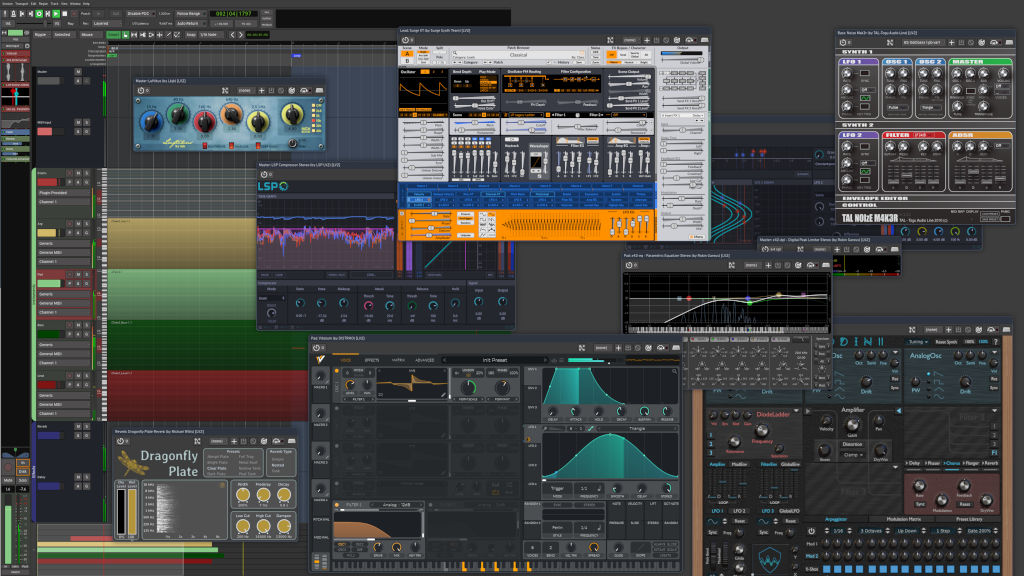
What does producing music on Linux look like today?
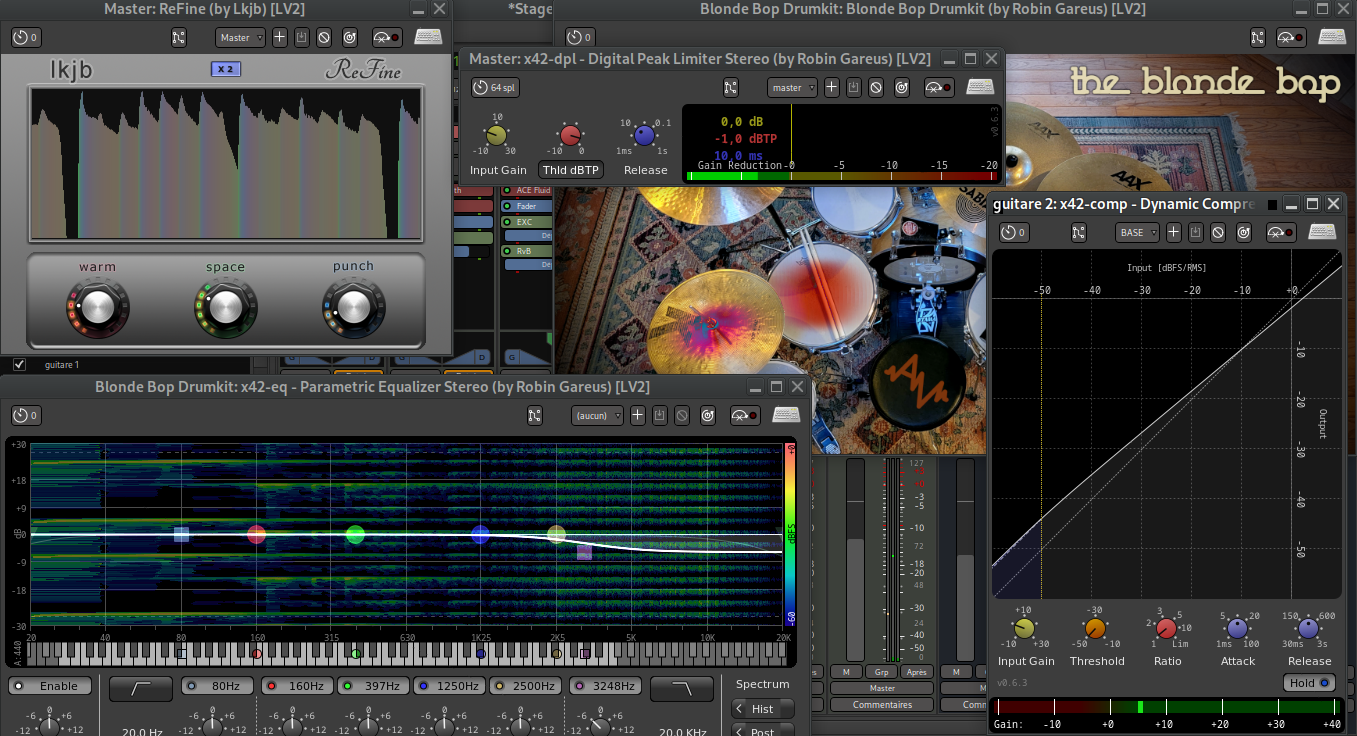
(<)(>)1/3 Bitwig Studio and a bunch of native Linux audio plugins running on Arch Linux GNOME (by Amadeus Paulussen).2/3 Ardour with a bunch of native (mostly FOSS) Linux audio plugins running on NixOS SwayFX (by Vivien).3/3 Ardour with a bunch of native FOSS Linux audio plugins running on LibraZiK MATE (by Nicolas Faure).
The availability of both proprietary (Bitwig Studio, Mixbus, Reaper, Fender Studio Pro, Waveform, etc.) and Open Source (Ardour, Qtractor, Zrythm, etc.) digital audio workstations (DAW) and the flexible audio subsystem of modern Linux distributions, PipeWire, make Linux a serious alternative to macOS and Windows when it comes to computer-aided music production.
Even independently of music production, Linux has come a long way and is now not only on a par with macOS and Windows in many areas, but even superior in some.
Of course, this does not mean that the experience of producing music with Linux is already on a par with the competition from Redmond and Cupertino in all respects. Especially when it comes to the range of available audio software or plugins, Linux still lags. And this even though it would be relatively easy for most audio vendors to compile and publish their audio software or plugins as native Linux versions, thanks to the widely adopted use of Open Source cross-platform frameworks such as JUCE.
And, yes, not all major digital audio workstations are available on Linux. For example, there is no Cubase, no Logic (obviously), no Pro Tools, no Live (even though Ableton uses a Linux version of Live with their Push hardware), and no FL Studio for Linux.
The bottom line is that Linux is absolutely ready for music production. However, depending on which DAW, which audio interface or which audio software or plugins users want/need, they may have to make concessions or hope for an improvement of the market situation, which is what we're aiming for with our initiative.
Why should I offer my audio software or plugins for Linux?
The current status of the Linux user base could be compared with that of macOS a few years ago. The macOS user base was also relatively small at the time, but it grew rapidly over time and with it the range of software available for macOS. We expect a similar development for Linux.
So, the decision for an audio vendor to support Linux is currently still more of an ideological nature. But since the effort on their side is usually manageable, and the move to support Linux also has a sympathetic effect on their brand, we think it is already worth going that route today.
How large is the target audience for paid Linux audio software or plugins?
A growing number of professional Linux users are willing to pay for software, as seen in other industries such as video production.
As of August 2025, Linux enjoys a share of the global desktop computer market of over 6%, with macOS above 15% and Windows still the dominant player at over 75%.
Should audio software or plugins for Linux be "Free and Open Source Software"?
audio software or plugins offered for Linux can be FOSS as well as proprietary and/or commercial.
Since Linux itself is so-called Free and Open Source Software (FOSS), one could assume that software distributed for Linux should also conform to this model. However, this is not the case.
And what about Linux Audio hardware support?
A significant challenge for Linux-based music production lies in the limited availability of drivers and software support for audio interfaces and other hardware devices.
Fortunately, some manufacturers—such as RME or Focusrite—design their audio interfaces to be USB Class Compliant, allowing them to function on Linux systems without the need for drivers or additional software.
However, while certain devices can be fully operated through their onboard controls, others rely on companion software to configure specific functions. For some products, such as Focusrite’s Clarett series, Open Source (FOSS) software alternatives are available to bridge this gap.
Which audio vendors already offer their software for Linux?
There is a growing number of audio vendors who offer their products for Linux.
How can I copy-protect my audio software or plugins on Linux? What about services like iLok?
On Linux, similar to macOS or Windows, a variety of methods can be employed for integrating a copy protection mechanism into software. These include the use of generated serial numbers, keyfiles, watermarks, or server-based username/password pairs and challenge/response systems for login/authentication purposes.
iLok is not yet available for Linux, although PACE has announced plans to support Linux in the future, albeit without a specific release date. See Linux Support Request Tracking for up-to-date information.
What do Linux users expect from audio vendors?
Linux users in general enjoy their freedom and usually do not want to be controlled or patronized by software vendors.
Invasive copy protection mechanisms and installers that do not transparently show users what is being installed where would most likely not be well received by typical Linux users.
Since many Linux users have advanced computer skills, they usually appreciate it when audio software vendors provide information about the build system used (e.g., distribution, libc/glibc version, etc.) for their software.
What are the system requirements for a Linux Audio development computer?
As Linux generally has low hardware requirements and is often installed and operated successfully on older computers, the requirements for developing and compiling audio software or plugins for Linux are actually very low.
What operating system should I use for development?
Many Linux audio developers use a stable, non-cutting-edge distribution such as Debian as their build system. This is to remain backward compatible with older versions of libc/glibc.
On cutting-edge distributions, it makes sense to use a container-based build system to compile the binaries against a non-cutting-edge libc/glibc version.
What formats should I distribute Linux audio plugins in?
On Linux, audio plugins are usually offered as VST3 and LV2, but also increasingly in CLAP format.
If your plugin is Open Source, providing build instructions is strongly recommended, allowing developers and advanced users to compile the plugin themselves.
What formats should I distribute Linux audio software in?
Flatpak should be considered the minimum distribution format, as it works across most Linux distributions and integrates with popular software center apps.
If your software is Open Source, providing build instructions is strongly recommended, allowing developers and advanced users to compile the software themselves.
With which DAWs and/or distributions should I test my Linux audio software or plugins?
As with other platforms, testing audio software or plugins with different distributions and/or DAWs is also worthwhile on Linux.
The numerous Linux distributions and Desktop Environments or Window Managers can be an additional factor.
Many audio vendors test their audio software or plugins on Linux only to a limited extent, e.g. with Debian and Ardour.
However, an ideal scenario would be to test at least two distributions, e.g. an Arch based distribution with KDE as the Desktop Environment and Debian with GNOME as the Desktop Environment.
Do I need to worry about PipeWire (vs JACK or PulseAudio) or Wayland (vs X11)?
The short answer is no.
The long answer for PipeWire—Linux's modern, flexible audio processing engine—is that it was developed from the ground up to replace both PulseAudio and JACK in everyday use and does so seamlessly (and with no further ado) via pipewire-jack and pipewire-pulse. While most distributions have already switched to PipeWire as their default, only a few DAWs, such as Bitwig Studio, currently support PipeWire directly. Ultimately, however, this plays a minor role in everyday use, thanks to PipeWire's backwards compatibility.
The long answer for Wayland is a bit more complex. As Linux's modern display server protocol, Wayland was developed as a direct replacement for X11. Thanks to Xwayland, a compatibility layer for X11 integrated into Wayland, X11 audio software or plugins work without issues in most cases on Wayland. Additionally relevant for audio plugins in particular: none of the popular audio plugin frameworks currently support Wayland directly. However, this is actively being worked on for some frameworks, such as JUCE and DPF, and workarounds exist for certain scenarios. For now, this means that if a digital audio workstation (DAW) does not offer X11 support, it can't be run on X11. For example, Fender Studio Pro does not offer X11 support. However, such a DAW can load X11 audio plugins via Xwayland on Wayland without issue. The user won't even notice.
Does Linux support high-resolution graphical user interfaces?
Yes, modern Linux Desktop Environments and Window Managers support high-resolution displays.
Just like macOS and Windows users, Linux users nowadays expect software to have graphical user interfaces that are sharp on high-resolution displays and that can be resized.
What frameworks can I use to develop audio software or plugins for Linux?
What issues can block audio software or plugins from being ported or distributed on Linux?
There are certain circumstances in which it is difficult, if not impossible, to make audio software or plugins Linux compatible.
1. If an audio plugin is dynamically linked and depends on external, system-wide, non-ABI libraries other than libc or libX11, it may not work. Like on other platforms, a plugin must not depend on external 3rd party shared libraries.
2. If audio software or plugins use APIs that are not available on Linux, they will need to be replaced before porting.
3. Using web views in an audio plugin could prevent it from running at all or result in it only being compatible with a very narrow subset of system configurations.
Can I get help from experienced Linux Audio developers if I run into problems?
In the long run, we would like to mediate between experienced Linux audio developers and such that are new to the topic, but unfortunately we are not there yet and currently can't offer any support in this regard.
After all, can't Linux users just use WINE/yabridge to run Windows audio software or plugins?
With the help of libraries such as WINE or yabridge, Windows audio software or plugins can be used under Linux. However, this is sometimes associated with trial and error, involves performance losses and does not work with all Windows audio software or plugins.
There's a new generation of Linux audio users who are not willing to accept a halfway functioning solution and only use native Linux software.